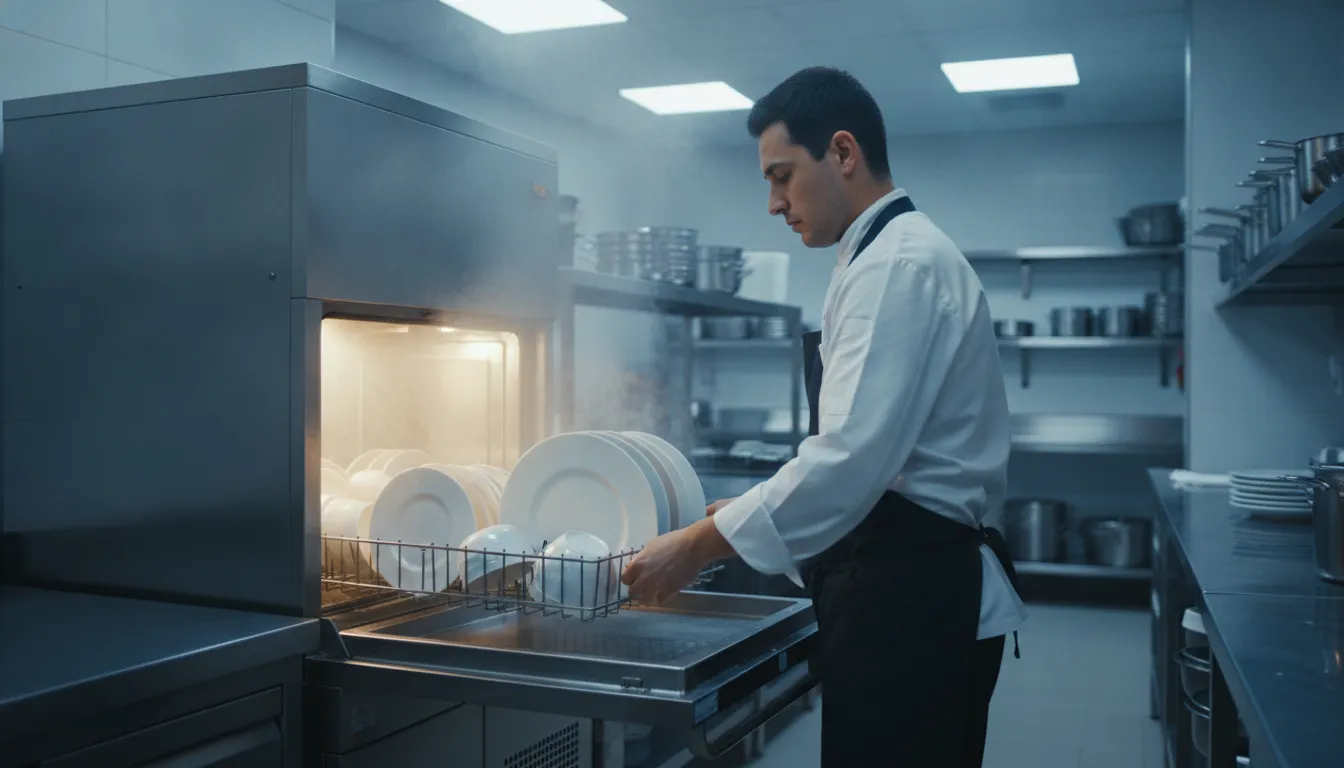
For a Rochester restaurant, the right dishwasher affects more than the closing shift. It influences how quickly clean racks return to the line, the space your dish area needs, and whether the unit can keep pace during your busiest service. Before you compare brands, identify your operator tier: the size and speed of machine your kitchen actually requires.
A commercial dishwasher buying guide for Rochester restaurants starts with a simple sizing flow: estimate seats and table turns, convert that peak volume into required racks per hour. Then match the result to the dishwasher type that fits your footprint, utilities, and sanitizing method.
Quick sizing flow
- Calculate peak volume: Count total seats and average table turns during your busiest hour.
- Convert to racks: Multiply peak covers by expected dish count, then divide by 15-25 settings per rack to find your target racks per hour (RPH).
- Select your tier: Undercounter for light peak volume and compact spaces; door-type for mid-volume kitchens (28-35+ RPH); rack conveyor or flight-type for high-volume continuous flow (up to 200 RPH).
Use your peak-hour number, not your average day. The sizing decisions covered here build on our commercial kitchen equipment planning guidance for Rochester kitchens, then focus on the dishwasher decisions that shape a practical purchase. The comparison table below gives busy operators instant clarity on type, footprint, and throughput before the granular details.
Get commercial dishwasher sizing and pricing help
Undercounter vs Door-Type vs Conveyor: Which Dishwasher Fits Your Restaurant?
The right commercial dishwasher is determined less by menu size than by the pressure your dish area faces during peak service. A compact operation may need to conserve every inch of back-of-house space, while a busy dining room or banquet kitchen may need continuous rack movement. Compare the four common types by available footprint, expected volume, and how dishes move through the kitchen.
|
Dishwasher type |
Best for |
Space footprint |
Racks per hour |
Typical venue |
|---|---|---|---|---|
|
Undercounter |
Low-volume dishwashing close to the point of use |
Smallest footprint; fits below a work counter |
Lower throughput; size to peak demand |
Cafe, bar, small restaurant |
|
Door-type |
Moderate volume with a dedicated loading and unloading area |
More room than an undercounter unit; requires working clearance |
Moderate throughput; depends on cycle and staffing |
Full-service restaurant, hotel kitchen |
|
Rack conveyor |
High-volume operations that process racks continuously |
Large footprint with defined entry and exit sides |
High throughput; some models can handle up to 200 racks per hour |
High-volume restaurant, cafeteria, commissary |
|
Flight-type |
Very high volume with a continuous dish flow |
Largest footprint; requires a planned warewashing line |
Very high throughput; confirm capacity with the manufacturer |
Institutional kitchen, large hotel, healthcare food service |
An undercounter machine is often the practical choice when the dish pit is tight and the operation has a manageable volume. It keeps the wash cycle close to prep or service, but its smaller capacity can become a bottleneck when racks accumulate quickly. A door-type unit adds capacity and a more structured loading workflow. It is a strong middle-ground option for restaurants that need more throughput than an undercounter model without dedicating the floor area required by a conveyor.
Rack conveyors are built for high-volume operations. Racks enter one side, move through the wash system, and exit ready for unloading, which supports a steadier flow during peak periods. Flight-type systems take that continuous approach further by moving dishes through a larger, integrated warewashing line. Their capacity can be valuable, but the footprint, utilities, ventilation, material-handling plan, and staffing requirements must all be considered before purchase.
Use your peak rack count, not your average day, as the starting point. Also measure aisle clearance, landing space, table position, drain location, power, and water connections. Sanitation performance depends on the machine, its installation, and consistent operating procedures, so a larger unit is not automatically the better choice. For help matching volume and layout to commercial kitchen equipment, review the full specification with a commercial equipment specialist before ordering.
Ask an HRS specialist which dishwasher type fits your kitchen
How to Calculate Dishwasher Capacity: Racks Per Hour vs Your Turn Rate
Capacity planning starts with your busiest service period, not your average Tuesday. A Rochester restaurant may move dishes through the warewashing area in waves, with a sharp increase after a lunch rush, during dinner turns, or after a catered event. Your commercial dishwasher needs enough throughput to keep pace with that peak without forcing staff to stack dirty wares in unsafe or inefficient ways.
Convert your meal turns into racks per hour
Begin by estimating the number of place settings, pans, and utensils that need washing during your busiest hour. Then group those items into the rack configuration your operation will actually use. The basic calculation is:
Required racks per hour = peak-hour dish volume divided by usable items per rack.
Build in a practical margin for scraping, loading, unloading, and the occasional oversized item. If your calculation produces 35 racks per hour, choosing a machine rated for exactly 35 racks can leave no room for delays. A higher rated unit may be appropriate if your menu creates heavy soil, your staff cannot load racks continuously, or your dish area serves multiple stations.
Remember that a machine's published rack rate is a throughput reference, not a promise that your kitchen will achieve that number every hour. Operators still need time to sort wares, remove food debris, replace racks, and move clean dishes back into service. High-capacity conveyor machines can wash up to approximately 200 racks per hour. But that level of capacity is intended for operations with the volume, floor space, and workflow to use it. A smaller restaurant may get better results from a door-type unit that matches its peak turn rate without consuming unnecessary space or utilities.
Peak vs average volume: a Friday-night example
Imagine a 60-seat Rochester bistro during a Friday 7 PM rush. The dining room turns roughly 1.5 times in that hour, so about 90 covers pass through the kitchen. Each cover produces a plate, a bowl, silverware, and a glass, plus a share of pots and pans from the line. Grouped onto standard racks, that works out to roughly 20 to 25 racks in the peak hour once you include glassware, pots, and plate turns. Add a margin for scraping, loading, unloading, and the occasional oversized tray, and the safe target is closer to 28 to 30 racks per hour.
Now compare with the average day. If that same bistro does 30 covers on a slow Tuesday, the average looks like 8 to 10 racks per hour, and an undercounter machine seems fine. But at Friday peak volume the kitchen needs a door-type unit that can sustain 28 to 30 racks per hour without staff stacking dirty ware in the aisle. That gap between average and peak demand is the single most common sizing mistake buyers make. The same peak-demand logic applies to every equipment purchase in our commercial kitchen planning guidance for Rochester operators.
Visualize the dish room layout before you measure
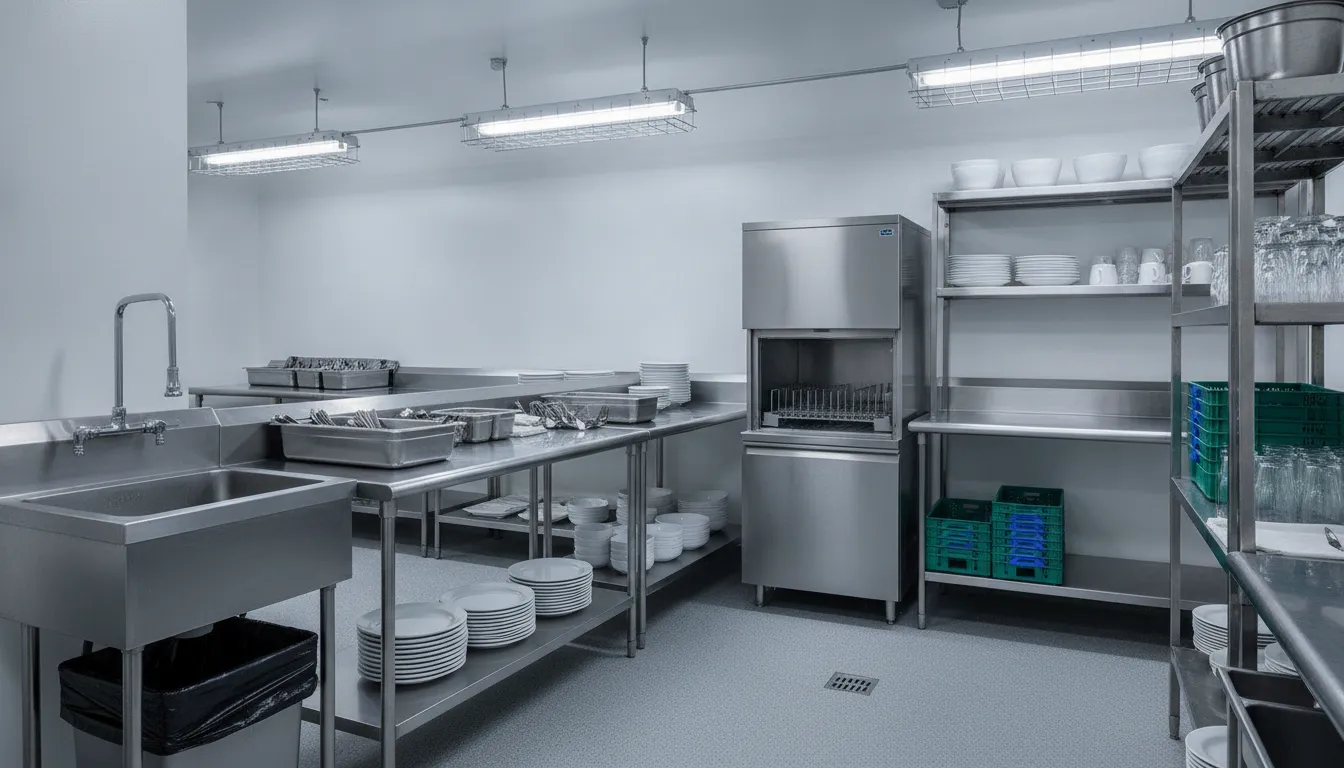
A dishwasher is only part of a dish room. Before you measure the machine footprint, map the workflow around it: a soiled dish drop-off and scraping station where dirty ware enters. Landing space where clean racks come out, and clean rack storage where washed ware waits to return to service. Each machine type changes that layout. An undercounter unit can slip under a counter at the point of use with a small landing table. A door-type machine needs clearance in front for the door to swing and room on both load and unload sides. A rack conveyor needs a defined entry side, exit side, and a longer run of dish tables for continuous rack flow.
Plan the sequence so dirty wares never cross the path of clean wares: drop-off, scrape, load, wash, unload to landing space, then store clean racks. Include room for a work table, rack storage, and an aisle wide enough for staff to pass with loaded racks. Drain location, power, and ventilation matter as much as the machine's width, so measure the whole run before ordering.
Check power, water, and drain requirements before selecting the unit
Capacity also has an infrastructure limit. Before comparing models, confirm the available electrical service, hot or cold water connection, incoming water pressure, drain location, ventilation needs, and space for service access. Facilities should assess daily volume, available space, and utility requirements such as power and water before purchase. The drain and floor layout matter just as much as the machine footprint, because a unit that cannot discharge water correctly can disrupt the entire dish area.
Sanitation requirements should remain part of the calculation. Commercial warewashing is tied to food-safety practices, and the machine must support the cleaning and sanitizing process your operation follows. FDA Food Code guidance provides a foundational reference for safe food-service practices, including equipment used in cleaning and sanitizing operations: FDA Food Code guidance. Confirm the applicable New York requirements and your facility's installation specifications with the appropriate professionals before ordering.
Finally, compare utility demand alongside racks per hour. ENERGY STAR notes that certified commercial dishwashers can reduce water use by up to 30%, which may help lower operating costs over the life of the machine: ENERGY STAR commercial dishwashers. The right unit handles your peak turn rate, fits your existing workflow, and can be installed with the power, water, and drain capacity your Rochester kitchen can support.
Get help calculating the dishwasher capacity your restaurant needs
Low-Temperature vs High-Temperature Commercial Dishwashers Explained
Temperature choice affects more than the final rinse. It shapes the equipment setup, operating costs, chemical program, ventilation needs, and daily workflow in a commercial food-service operation. The right option depends on your menu, peak dish volume, available utilities, and the sanitation procedures your team is expected to follow.
How low-temperature dishwashers sanitize
Low-temperature, or chemical-sanitizing, dishwashers use a final rinse at a lower heat level and rely on an approved sanitizing chemical to complete the process. That approach can reduce the heating load and may suit a facility with limited hot-water capacity. It also requires dependable chemical dispensing, correct chemical concentration, and disciplined staff training. If the chemical supply is empty, the dispenser is not calibrated, or the final rinse is not verified, the machine is not delivering the intended sanitation result.
Chemical sanitizing can be a practical fit for smaller commercial kitchens, operations with constrained electrical service, or facilities that already have a well-managed chemical program. However, chemical costs become part of the ongoing operating budget. Operators should account for sanitizer, dispensing maintenance, testing, and staff procedures rather than comparing equipment prices alone.
How high-temperature dishwashers sanitize
High-temperature, or heat-sanitizing, dishwashers use a hotter final rinse to sanitize cleaned wares. They reduce reliance on chemical sanitizer, which can simplify one part of the warewashing routine. But they place greater demands on the water heater, booster heater, electrical service, and kitchen ventilation. The machine must maintain its required wash and rinse temperatures consistently, including during busy service when racks move through continuously. Booster heater performance also depends on incoming water temperature, so in Rochester winters a cold water supply can slow recovery. Size the booster for the coldest inlet temperature your building sees, not a summer average.
Heat sanitizing may be attractive for operations that prefer a chemical-light process or need to support established hygiene conventions built around a hot final rinse. It does not eliminate the need for detergent, pre-scraping, correct loading, routine temperature checks, or staff compliance. A hot rinse cannot compensate for food soil left on a dish or an improperly maintained machine.
Low-temp vs high-temp cost matrix
| Cost driver | Low-temperature (chemical sanitizing) | High-temperature (heat sanitizing) |
|---|---|---|
| Upfront equipment | Generally lower; no booster heater required | Higher with booster heater and added electrical capacity |
| Ongoing chemical cost | Higher; sanitizer, detergent, and dispensing upkeep | Lower chemical reliance; detergent and rinse aid only |
| Energy and hot water | Lower heat load; suits limited hot-water capacity | Higher; booster power and hot-water demand rise |
| Drying speed and glassware | Slower drying; chemical film can cloud glassware | Faster drying; hotter rinse protects glass clarity |
| Ventilation | Less ventilation demand | More ventilation and condensate management |
Neither configuration is automatically less expensive in every kitchen. A low-temperature unit may use less energy for heating but consume more sanitizer and can cloud glassware over time. A high-temperature unit may reduce chemical dependence while increasing energy demand and requiring additional hot-water infrastructure. Water consumption also varies by model, cycle design, rack volume, and operating habits. ENERGY STAR certified commercial dishwashers can reduce water usage by up to 30%, according to ENERGY STAR's commercial dishwasher guidance, which can help lower utility costs over the equipment's service life.
Before choosing, confirm the required temperature and chemical parameters with your local health authority, equipment provider, and chemical supplier. Then compare total operating requirements against your peak service volume. Evaluate the complete system, not just whether the machine is labeled low-temperature or high-temperature.
Health Department Requirements for Commercial Dishwashers in New York State
For a New York restaurant, a commercial dishwasher is part of the food-safety system that protects your operation's revenue. A failed inspection can mean a corrective-action plan, a shutdown order, or a public relations problem right before a busy weekend. Warewashing that consistently cleans and sanitizes plates, pans, utensils, and other food-contact items keeps your doors open and your service running.
In New York, the New York State Department of Health publishes food-service sanitation guidance that addresses warewashing, including cleaning, water temperatures, and chemical sanitization practices. Verify the applicable guidance with NYSDOH and the local authority having jurisdiction before ordering, because requirements can affect machine selection and installation details.
The FDA Food Code provides a foundational reference for cleaning and sanitizing food-contact equipment. New York operators should also verify current state and local expectations with the authority that inspects the establishment. A buying decision should leave room for those requirements rather than treating a machine's cycle time or rack capacity as the only specification that matters.
Choose the correct sanitizing method
Commercial warewashing generally relies on either high-temperature sanitizing or chemical sanitizing. A high-temperature machine uses a hot final rinse to reduce microorganisms after the wash cycle. A low-temperature machine uses an approved chemical sanitizer at the required concentration and contact time. Neither approach is automatically compliant in every kitchen. The machine, plumbing, ventilation, chemical system, and operating procedures must work together and meet the applicable sanitation standard.
Ask the dealer or installer to document which sanitizing method the dishwasher uses and what the operation must monitor. For a high-temperature unit, staff need a reliable way to confirm that the wash and final-rinse temperatures reach the equipment's required levels. For a chemical-sanitizing unit, the kitchen needs the correct chemical supply, dispensing equipment, test method, and staff procedure for verifying concentration. Do not substitute a general temperature assumption or a visual check for the manufacturer's specifications and the inspecting authority's requirements.
Maintain washing and rinsing efficacy
Sanitation depends on the complete cycle. Scrape and pre-rinse ware as needed, load racks so water reaches every surface, and avoid overloading compartments. Detergent, rinse aid, water pressure, temperature, and sanitizer delivery all affect results. If spray arms, filters, nozzles, or chemical lines are blocked, even a properly sized machine can leave soil behind or fail to sanitize consistently.
Build opening, closing, and periodic checks into the kitchen's food-safety routine. Staff should watch for unusual residue, cloudy glassware, weak spray, chemical alarms, or temperature readings outside the machine's operating range. Keep service and calibration records available, and correct problems before ware is returned to food service. The cost of a failed inspection is almost always higher than the cost of the checklist that prevents one.
Protect food-contact surfaces after the cycle
Clean ware must be handled as carefully as it was washed. Use clean racks, allow items to air-dry when required, and store them in a way that protects food-contact surfaces from splash, hands, raw-food debris, and floor-level contamination. A clean-looking plate is not proof that the process worked. Routine verification, including an appropriate monitoring method for the operation, can help identify contamination risks on food-contact surfaces before they affect service.
When comparing commercial dishwashers, include sanitation documentation, utility requirements, staff training, and service support in the specification. That approach helps Rochester operators select equipment that can sustain compliant warewashing through the busiest service. Rather than discovering after installation that the machine cannot support the kitchen's sanitation process.
Commercial Dishwasher Cost Drivers: Planning Beyond the Sticker Price.
When budgeting for a commercial dishwasher in a Rochester kitchen, focusing solely on the machine's base price tag can lead to unexpected surprises. A realistic project budget accounts for the machine type, necessary facility upgrades, dish room layout additions, and long-term operating costs.
Rather than a single fixed quote, your total investment is determined by a few key project drivers:
Machine Type & Processing Capacity
The size and continuous throughput your kitchen requires will set the baseline equipment tier for your project:
- Undercounter Units: Compact and cost-effective for lower volumes, bar tops, or auxiliary prep areas.
- Door-Type (Single/Double Rack): Mid-tier investment offering high speed and flexibility for standard full-service dining rooms.
- Conveyor & Flight-Type Systems: Higher-capacity investments designed for sustained, high-volume washing without workflow bottlenecks.
Site Infrastructure & Facility Prep
Facility requirements often represent a significant portion of the total project setup. Existing utilities directly dictate what additions are necessary before installation:
- Water Heating & Boosters: High-temperature units require an external or integrated booster heater to consistently hit sanitation temperatures during cold Rochester winters.
- Electrical Requirements: Upgrading to dedicated multi-phase power or higher amperage capacity depending on your building’s current panel setup.
- Ventilation & Steam Management: High-heat or continuous-run machines may require a condensate hood or specialized ventilation to manage moisture in the dish room.
- Water Quality & Treatment: Rochester’s water hardness can cause scale buildup, shortening equipment life. Adding a dedicated water softening system protects your unit and prevents mineral haze on glassware.
- Dishtables & Workflow Layout: Adding dirty-dish drop areas, scrap sinks, overhead racks, or clean-side landing space to complete the wash line.
Long-Term Utility & Operational Costs
Ongoing operational demands should be factored into your total cost of ownership over the lifespan of the machine:
- Sanitizing Method: Low-temp machines require ongoing chemical sanitizer supplies, while high-temp machines increase peak electrical and water-heating demand.
- Utility Efficiency: ENERGY STAR® certified commercial dishwashers reduce water usage by up to 30%, noticeably lowering monthly water, sewer, and heating bills.
- Preventative Maintenance: Routine filter changes, descaling, and scheduled service extend machine life by 5 to 10 years, dramatically lowering your long-term annual cost.
Get a Customized Project Estimate
Every Rochester kitchen layout and utility setup is unique. Rather than relying on generic averages, reach out to the Henrietta Restaurant Supply team for a site assessment and customized quote tailored to your space, peak volume, and budget.
Request Custom Dishwasher Pricing & Sizing Assistance
Where to Buy Commercial Dishwashers in Rochester NY
For Rochester restaurant operators. The best place to buy a commercial dishwasher is close to home: the Henrietta Restaurant Supply showroom at 900 Jefferson Road in the Genesee Valley Regional Market. HRS is a local, M/WBE-certified company built by industry veterans with more than 60 years of combined experience in restaurants, catering, and commercial equipment. The people helping you choose the right unit have worked the dish side of real kitchens themselves.
Buying local means you compare machines in person instead of guessing from spec sheets. You can open the doors, check the footprint, and talk through your service volume with a specialist on the spot, then ask our team which dishwasher fits your operation before you commit.
Why Rochester operators buy from HRS
HRS stocks thousands of products for immediate purchase, offers consultative help for complex installations and kitchen design, and carries a 4.7-star Google rating from local operators. The showroom is open to everyone, with no membership or wholesale minimums, and the staff bring real restaurant experience to every recommendation.
Get a recommendation from the HRS equipment team
What to bring when you visit
Start the conversation with the details that shape the purchase: your estimated racks per hour during peak service. The number of meals or covers your team handles in the busiest turn, and the dimensions of the planned installation area. It also helps to know where the dish landing, scraping, washing, and storage areas will sit. These details let an HRS specialist connect capacity with your workflow instead of recommending a machine based only on a listed cycle time.
Bring a quick-reference checklist so you can compare machines on an even basis: planned footprint including door swing and aisle clearance. Required electrical service, water connection type, drain location, and ventilation needs, plus your peak racks per hour and preferred sanitizing method. Ask about booster heater requirements, water softener fit, and delivery and installation scope. Having these numbers in hand turns a showroom tour into a real sizing session, and you can grab our contact page or directions to the showroom before you head out.
Delivery, installation, and support after the sale
Buying from HRS gives you a clear, hassle-free path to delivery and setup across Rochester and Western New York. We offer tailored delivery, installation, and removal services designed to fit your specific needs:
Flexible Service Scope: We quote commercial equipment delivery per job. Options can include on-site delivery, placement, old unit removal, equipment connections, and startup guidance.
Coordination & Prep: Your plumber, electrician, or installation team may need detailed specs before your dishwasher arrives. HRS coordinates the entire process to keep your project moving smoothly.
Comprehensive Project Support: From a single supply item to complete kitchen design and renovation projects, we manage your kitchen buildout end-to-end.
Contact our team before delivery to confirm your exact site scope and schedule your service.
Talk to the HRS team about choosing the right commercial dishwasher
Frequently Asked Questions
What should I confirm before choosing a commercial dishwasher?
Measure the available space, identify power and water connections, and estimate your busiest service period. Then compare the required racks per hour with the machine's rated capacity. The right unit should keep pace with peak dish volume without forcing staff to queue racks or interrupt service.
What is the difference between an undercounter and a conveyor dishwasher?
Undercounter models fit compact layouts and lower-volume operations, while conveyor models move racks through the wash process for high-volume service. A door-type unit is often a practical middle option when a restaurant needs more throughput than an undercounter machine but does not have the footprint or volume for a conveyor.
Is a low-temperature or high-temperature dishwasher cheaper to run?
It depends on your utilities and chemical program. A low-temperature machine avoids booster heater costs but adds ongoing sanitizer expense and can cloud glassware over time. A high-temperature machine spends more on boosting water temperature but dries faster and relies less on chemicals.
Do I need a water softener for a commercial dishwasher in Rochester?
Often yes. Rochester's hard water can shorten dishwasher life and leave mineral film on glassware, so a water softener is frequently worth including in the installation budget. Test your water and confirm with your equipment supplier before ordering.
Which commercial dishwasher type is best for a high-volume restaurant?
A rack conveyor or flight-type dishwasher is generally the better starting point for a large operation with sustained dish volume. High-capacity conveyor machines can wash up to about 200 racks per hour. Confirm the actual throughput against your peak meal-turn rate and available loading space.
How often should a commercial dishwasher be maintained?
Use a preventive maintenance schedule based on the manufacturer's requirements, operating hours, and water conditions. Daily cleaning and routine inspections should be part of closing procedures, while qualified service should address wear, leaks, temperature performance, and sanitizing components. Proper maintenance may extend service life by five to 10 years, according to Champion Industries.
Ready to Choose the Right Commercial Dishwasher?
The right dishwasher setup can help your Rochester restaurant match cleaning capacity to peak service, available space, and day-to-day workflow. For practical guidance on selecting a suitable type and size, ask Henrietta Restaurant Supply to review your operation and next steps.