How to Choose a Commercial Ice Machine for Bars
A bar can run out of ice long before its busiest service ends, while an oversized unit can take up valuable space and cost more to operate. Choosing the right commercial ice machine starts with your peak demand, menu, available utilities, and the type of ice your staff actually uses.
Contact Henrietta Restaurant Supply for commercial ice machine guidance.
Quick answer: The right machine should cover your busiest service demand and provide enough storage between production cycles. It should make the ice form your menu needs. It must also fit the room's water, drain, electrical, airflow, and service requirements. Compare the complete installation, not just the production number or purchase price.
This same application-first process belongs in a broader commercial kitchen equipment plan. The sections below give bar and restaurant operators a practical way to narrow the choice before requesting a specification or installation review.
How Many Pounds of Ice Does Your Bar Need Per Day?
As a starting planning estimate, a beverage-led bar can model roughly 1 to 2 pounds of ice per guest per day. Then replace that estimate with actual usage from busy shifts. A cocktail program, patio, fountain service, food display, or catering operation can require more. Treat pounds per guest as a worksheet input, not a universal sizing rule.
Separate production from storage
Production capacity is the amount of ice a machine can make under stated test conditions. Storage capacity is the amount of finished ice the bin can hold for immediate use. Those numbers solve different problems. A high-production machine with a small bin may struggle during a sudden rush. A large bin paired with a slow maker may run empty before the next production cycle catches up.
When reviewing a commercial ice machine, confirm that the maker and bin are designed to work together. Also note whether ice feeds a bar station, fills insulated carriers, supports kitchen prep, or serves several points of use. Each delivery pattern affects the reserve you need.
Build a demand estimate from real service
Use your busiest normal day rather than a weekly average. Pull beverage counts, cover counts, event history, and staff observations where available. List each source of demand separately:
- Cocktails, mixed drinks, soft drinks, iced coffee, and water service.
- Raw bar, seafood, produce, salad, or dessert display applications.
- Ingredient chilling, prep, transport, catering, patio service, or banquet demand.
- Peak turns, seasonal volume, special events, and multiple service stations.
Then compare the estimate with daily production, storage, delivery timing, and a measured operating buffer. A cocktail-focused bar may draw more ice per guest than a dining room with mostly bottled beverages. Do not force both operations into the same pounds-per-seat formula.
Adjust ratings for the installation environment
Manufacturer capacity ratings use defined ambient air and water temperatures. Actual output can change when the kitchen is hot, airflow is restricted, water temperature is higher, or the unit sits near a range, grill, fryer, or oven. Ask how the published rating relates to the planned room. Size for the conditions your team will actually face.
Food-service equipment guidance also supports matching production capacity to the operation's demand rather than choosing by capacity alone. Confirm final specifications with the manufacturer and installer.
Which Ice Type Fits Your Bar or Restaurant?
Ice shape affects drink dilution, texture, presentation, handling, and refill frequency. Choose based on the menu and workflow, not on the name of the shape alone. A bar serving cocktails has different priorities from a restaurant displaying seafood or a quick-service operation focused on fountain drinks.
| Ice type | Common fit | Operational strengths | Watch-outs |
|---|---|---|---|
| Full or half dice. | Cocktails, soft drinks, water, and general service. | Versatile and durable. It melts more slowly than smaller soft forms. | May not provide the texture or food coverage some menus need. |
| Nugget. | Fountain beverages and menus that feature chewable ice. | Soft texture and a familiar beverage-service experience. | Can melt and dilute drinks faster. This can increase refill demand. |
| Flake. | Seafood, produce, salads, displays, and food transport. | Conforms closely around products and provides broad surface coverage. | Usually less suitable as the primary ice for cocktails and mixed drinks. |
Match the form to the menu
Full or half dice is often a flexible starting point for a bar that serves cocktails, soft drinks, and water. Nugget can make sense where guests expect soft, chewable ice or where fountain beverages drive volume. Flake can be useful when the operation needs to surround food, protect a display, or cool products in shallow beds of ice.
Melt rate is not automatically good or bad. Faster melting can help ice conform to a display or cool a product quickly. Slower melting can help preserve drink balance during service. Consider the scoop, bin access, distance to service stations, and whether staff can refill without crossing the kitchen during peak volume.
Plan storage and sanitation with the ice form
Ice form changes how staff handle the bin and how often they replenish stations. Set a clear scoop location, keep hands and service tools out of the ice, and establish a cleaning routine for the maker and bin. The CDC recommends regular cleaning and sanitizing because neglected ice equipment can support bacteria and other microorganisms. Use the CDC ice-safety guidance alongside the manufacturer's cleaning instructions and your food-safety program.
Should You Choose an Air-Cooled or Water-Cooled Machine?
Air-cooled, water-cooled, and remote-condenser systems solve the heat-removal problem in different ways. The best choice depends on room temperature, airflow, water use, drainage, noise, available clearances, and service access. No cooling method is correct for every Rochester restaurant or bar.
| System | Advantages | Planning considerations |
|---|---|---|
| Air-cooled. | Generally uses less water and has a straightforward utility layout. | Needs adequate clearance and airflow. It releases condenser heat into the room. |
| Water-cooled. | Can be useful where ambient heat makes air cooling difficult. | Uses more water. Plan supply, drainage, filtration, and maintenance carefully. |
| Remote condenser. | Moves much of the heat and noise away from the main kitchen. | Requires refrigerant piping and specialized installation. Review clearances and outdoor conditions. |
For many kitchens, air cooling is a practical starting point when the room has dependable ventilation and enough clearance. Do not place the unit in a tight corner or beside heat-producing cooking equipment. Water cooling may be useful in a hot, constrained production area. The tradeoff is higher water use and a greater need to plan drainage and water quality.
The EPA's commercial ice-machine guidance addresses water use, airflow, and placement considerations. Review the EPA WaterSense ice-machine guidance before finalizing the footprint. Confirm the manufacturer's clearances, water connections, drain route, electrical service, and maintenance access for the exact model.
A remote condenser can reduce heat and noise in a compact bar, but it is not a simple substitute for an air-cooled unit. The installation must account for refrigerant piping and service access. Have the installer review the complete route before the equipment is ordered.
How Do You Size a Commercial Ice Machine by Seating Capacity?
Seat count helps establish the scale of an operation, but it cannot size a machine by itself. A 40-seat cocktail bar with several turns may use more ice than a larger dining room with limited beverage service. Use seating as one input, then build a demand picture around the actual menu, service period, and storage plan.
- Record seats and turns. Include dining seats, bar seats, patio seats, banquet seating, and the number of guests served during the busiest shift.
- List every ice use. Separate cocktails, fountain drinks, iced coffee, water, food display, ingredient chilling, transport, and catering.
- Estimate peak demand. Use portions, container sizes, beverage counts, and event history. Start with a pounds-per-guest estimate only as a placeholder.
- Compare production and storage. Check daily production against demand. Then confirm the bin can cover the busiest draw between production cycles.
- Review the room. Note temperature, airflow, clearances, water supply, drain route, electrical requirements, and nearby cooking equipment.
- Add a measured buffer. Allow for a busy event, delayed delivery, short production interruption, or seasonal increase without inventing a percentage that does not fit your operation.
- Track after opening. Measure ice use during several peak shifts. Adjust ordering, storage, or production planning if actual demand differs from the estimate.
For a wider equipment plan, connect this worksheet to your menu, labor pattern, utility capacity, and proposed kitchen layout. An ice machine that fits the production number but blocks a service aisle or lacks a workable drain is not the right machine for the operation.
What Should You Compare Between Ice Machine Brands?
Brand recognition can narrow the field, but it should not make the decision by itself. Hoshizaki and other commercial manufacturers offer equipment for different operating environments, capacities, ice forms, and installation configurations. Compare the exact application and model, not just the name on the front.
Review the full specification
Compare production at the stated air and water conditions, bin compatibility, ice form, footprint, electrical requirements, water connections, drain requirements, noise, clearances, and maintenance access. Ask whether the proposed setup works with your service stations and whether staff can safely reach the bin during a rush.
Check the warranty terms before approval. Confirm which components are covered, whether labor and parts are included, how service requests are handled, and which maintenance steps the owner must document. A strong warranty is useful only when its terms and service process are clear.
Consider service and total ownership
Parts availability, technician access, water filtration, cleaning, descaling, and expected utility use all affect downtime and ownership cost. An efficient machine may lower operating expense, but the lowest purchase price is not automatically the lowest long-term cost. Compare the complete solution and identify who will handle plumbing, electrical, refrigerant, and preventive maintenance work.
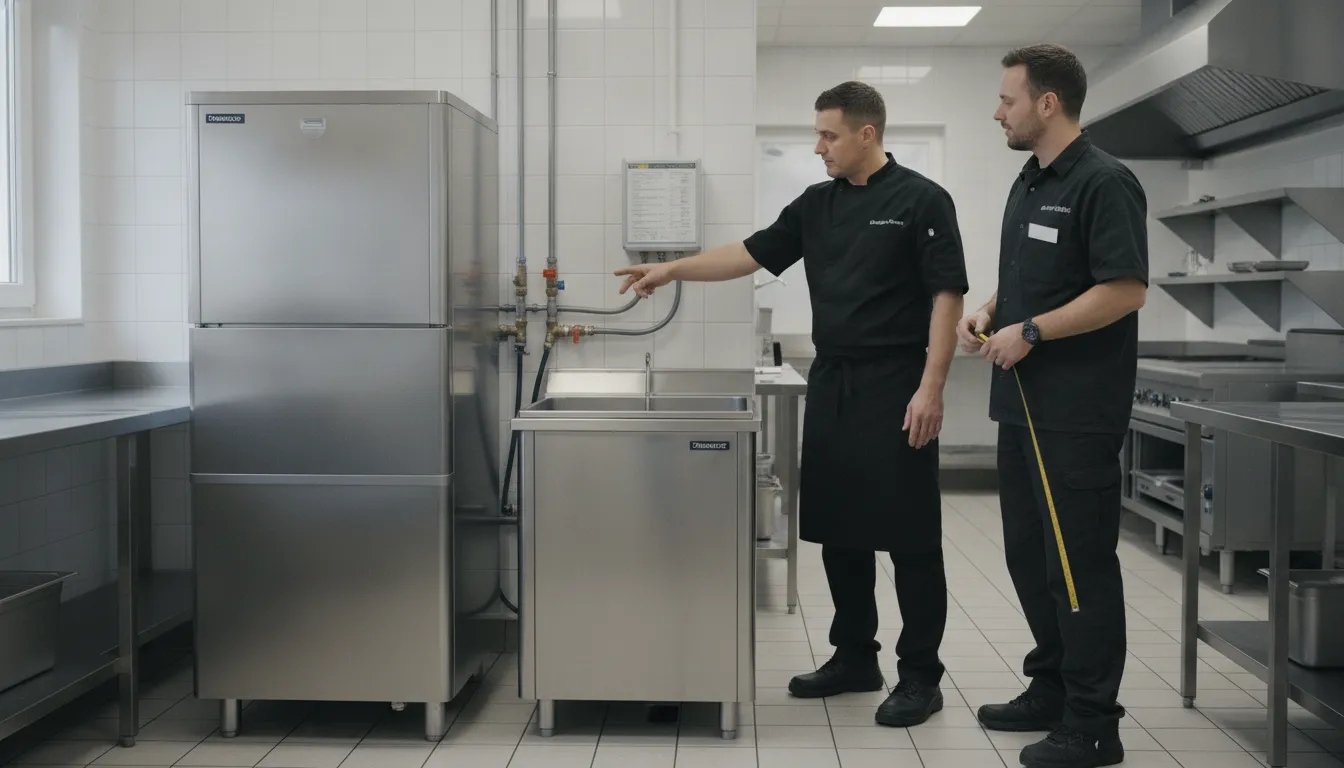
Henrietta Restaurant Supply can help operators compare commercial kitchen equipment solutions against the menu, space, production target, and support plan. The goal is a machine that keeps service moving, not a specification that looks good in isolation.
What Does a Commercial Ice Machine Cost to Install and Operate?
The machine price is only one part of the investment. A realistic review includes the maker, storage bin, stand, water treatment, drainage, electrical work, ventilation, installation labor, maintenance, warranty coverage, and utility use. Ask for a complete equipment and installation scope before comparing quotes.
Map the installation requirements
A modular unit may need a separate bin, while an undercounter configuration may combine production and storage differently. Confirm the planned location's water supply, floor drain or standpipe, electrical service, condensate management, clearances, and service access. If the machine is near a cooking line, review heat and airflow before committing to an air-cooled configuration.
Include operating and maintenance costs
Review energy and water consumption alongside production capacity. ENERGY STAR certified commercial ice machines have historically used less energy and water than standard models. Actual savings depend on the model, schedule, water conditions, and room environment. Treat certification as one comparison point, not a guaranteed payback.
Maintenance protects both food safety and the investment. Follow the manufacturer's cleaning and sanitizing schedule, keep the bin closed or covered when it is not in use, and replace water filters as required. Hard-water scale can reduce heat-transfer efficiency and make service more difficult, so include filtration and descaling in the ownership plan.
Before approving an installation, ask who handles plumbing, electrical, drainage, refrigerant work, cleaning, and service. Confirm the required clearances and the expected maintenance interval. Planning these details early reduces surprises after the machine arrives.
Frequently Asked Questions
What size commercial ice machine do I need for my restaurant?
Choose production and storage based on peak demand, menu, service turns, ice form, and delivery timing. Seating is useful as a starting input, but it cannot account for cocktails, fountain drinks, food displays, catering, patios, or prep. Track actual use when possible and have the selected model reviewed against the room's utilities and clearances.
How much ice does a commercial ice machine produce per day?
Daily production varies by model and is stated under defined air and water conditions. Read the manufacturer's rating together with the bin capacity, then adjust expectations for room heat, airflow, water temperature, filtration, and maintenance. A machine can produce enough over 24 hours and still leave a service gap if the bin is too small.
Is an air-cooled or water-cooled commercial ice machine better?
Neither is universally better. Air-cooled units generally use less water but add heat to the room and require adequate airflow. Water-cooled units may help in hot or constrained spaces but use more water and demand careful drainage planning. Select the system after reviewing the installation environment and local utility requirements.
How often should a commercial ice machine be cleaned?
Follow the manufacturer's schedule and your food-safety program rather than waiting for visible buildup. Regular cleaning and sanitizing help reduce contamination risk, while filtration and descaling protect performance. Keep the bin closed or covered when it is not in use, and document the work so staff follow the same process.
Can I install a commercial ice machine outdoors?
Only when the specific unit and installation are approved for the intended outdoor conditions. Confirm temperature limits, weather protection, drainage, water supply, electrical requirements, clearances, and service access. Do not assume an indoor-rated machine can operate outside. Have an equipment professional review the location first.